Price per Square Metre for Real Estate
What the Price per m² Really Tells You
Anyone who deals with real estate will sooner or later come across the price per square metre. Whether in property listings, market reports or property valuations, the price per square metre is one of the most important metrics when it comes to comparing properties.
But what does the price per square metre actually tell us? How is it calculated correctly? And why can one square metre of living space be worth several thousand Swiss francs more or less in another municipality – or even on the same street?
In this article, you will learn how the price per square metre is determined, which factors influence it and how property prices in the Canton of Zug have developed over the past few years.
Table of Contents
- The Price per Square Metre as an Important Benchmark
- How to Calculate the Price per Square Metre Correctly
- Which Factors Influence the Price per Square Metre?
- Development of Property Prices in the Canton of Zug
- Conclusion
The Price per Square Metre as an Important Benchmark
When buying a property, almost every prospective buyer will sooner or later ask the same question: Is the asking price justified?
Since properties differ in terms of location, size, condition, quality, age and many other characteristics, making a direct comparison is often difficult. This is where the price per square metre can help. It enables buyers to better assess the asking price of an apartment or house and compare different properties with one another.
The price per square metre is also an important reference point for sellers. It provides a basis for determining a market-oriented price and helps establish a realistic asking price.
However, it is important to remember that the price per square metre is only a benchmark. It does not replace a professional property valuation, which takes into account all the relevant characteristics of a property. Rather, it is calculated based on the determined market value.
How to Calculate the Price per Square Metre Correctly
The calculation is straightforward:
Purchase Price ÷ Living Space = Price per m²
However, for different properties to be genuinely comparable, they should be assessed using the same standard.
A common pitfall is parking spaces.
If underground or outdoor parking spaces are included in the purchase price, their value should be deducted from the total price when calculating the price per square metre. Otherwise, the price per square metre will appear artificially high, even though part of the purchase price does not relate to the living space at all.
The living space itself also deserves a closer look. Depending on the listing or data source, different area standards may be used, such as net living area or gross living area. Unfortunately, it is not always clear which standard has been applied. This can distort the calculation of the price per square metre and reduce comparability.
Therefore, anyone comparing properties should, wherever possible, make sure that both the purchase price and the underlying living space have been calculated according to the same criteria.
For single-family homes, a different approach may also be more appropriate. If a house requires substantial renovation or sits on a large plot with significant development potential, the price per square metre of living space often tells us very little. In such cases, the price per square metre of land or potential living space based on the current utilisation ratio may be the more meaningful metric.
Which Factors Influence the Price per Square Metre?
Why does one apartment in the same municipality cost CHF 14,000 per square metre while another costs CHF 19,000?
The reason is that the price per square metre is influenced by numerous factors. Professional property valuations therefore use so-called hedonic valuation models. Using a mathematical model based on a large number of actual property transactions, it is possible to determine which characteristics buyers particularly value and how strongly these characteristics influence market value.
The most important influencing factors include:
Location
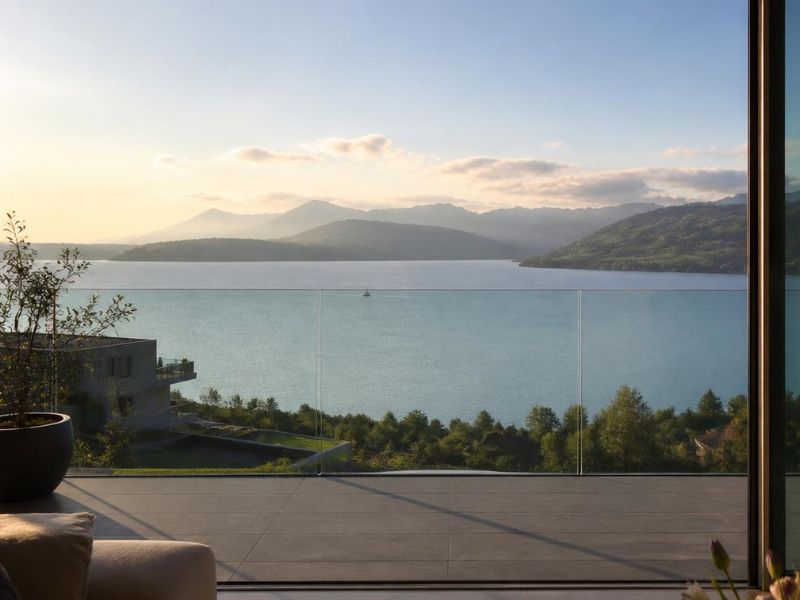
Location remains the most important price driver for a property. Both the macro location – such as the municipality or region – and the micro location within a municipality play a decisive role.
Tax-attractive municipalities, proximity to economic centres, good public transport connections and nearby shopping facilities can all have a positive impact on prices, as can a quiet residential setting, unobstructed views or attractive exposure to sunlight.
Age and Condition
Newer or comprehensively renovated properties generally achieve higher prices per square metre than older properties requiring renovation.
Exceptions include properties of particular appeal or historically significant buildings, where other factors determine the market value.
Read more about renovation before selling a property →
Living Space
An interesting effect can be observed when it comes to the size of an apartment: the smaller the apartment, the higher the price per square metre tends to be.
For example, a modern 2.5-room apartment with 60 m² will often achieve a significantly higher price per square metre than a comparable 5.5-room apartment with 150 m² in the same municipality. The total purchase price is higher, but the price per square metre is lower.
Quality of Finishes
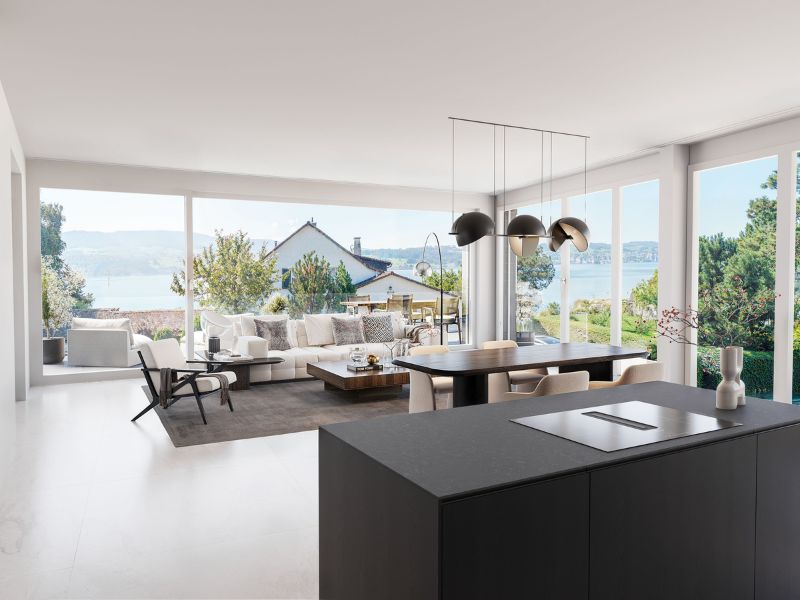
The quality of the interior finishes also influences the price per square metre. High-quality kitchens, premium flooring or modern bathrooms increase the perception of value of most buyers.
However, the same principle applies here: not every investment can be passed on to the buyer in full when the property is sold. The value and relevance of renovations should therefore always be assessed individually.
Development of Property Prices in the Canton of Zug
The price per square metre is not only useful for comparing individual properties, but also for observing the development of the real estate market over longer periods of time.
A look at the figures clearly illustrates how significantly property prices in the Canton of Zug have increased.
While the average price per square metre was still CHF 7,120 per square metre in the first quarter of 2003, it had reached CHF 19,757 per square metre by the first quarter of 2026.
This corresponds to an increase of around 177 percent over a period of just over 23 years. In other words, prices per square metre in the Canton of Zug have almost tripled during this period.
The following chart illustrates this development over time.
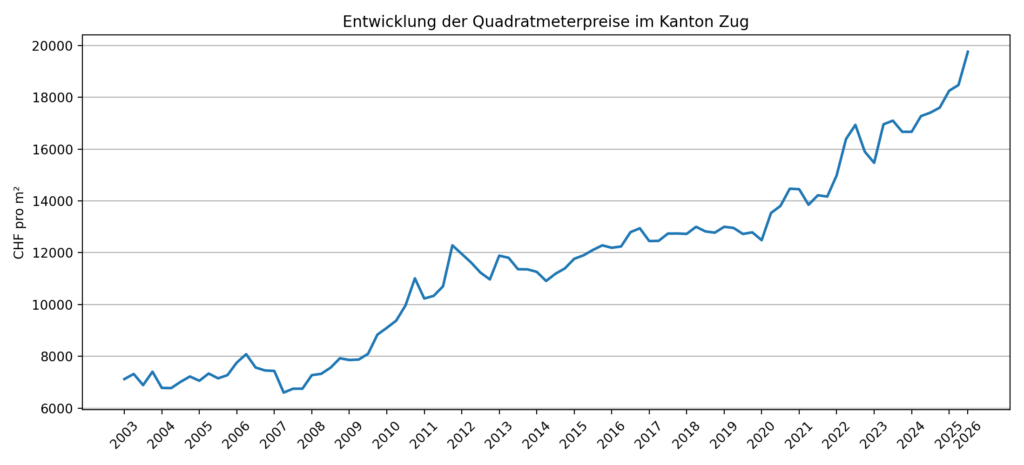
Source: Statistical Office of the Canton of Zug, development of prices per square metre.
Conclusion
The price per square metre is one of the most important metrics in the real estate market. It helps buyers better assess asking prices and supports sellers in determining a market-oriented selling price.
At the same time, the price per square metre should never be considered in isolation. Location, condition, quality of finishes, living space and many other factors influence the actual market value of a property. Even the best benchmark therefore cannot replace a professional property valuation.
Anyone looking to assess the value of their property realistically should use the price per square metre as a reference point – and always consider it in the overall context of the property.